
Jodi McCarthy and Her Perspective on Teen Mental Health
by Eleanor Hahnel, The Echo (Encinal Jr/Sr High School News Site)
March 24, 2026
Read the original article here.

Jodi McCarthy
Teen mental health is an important topic to discuss, yet it is not talked about often due to social stigma, and because it is deeply personal. Many teens struggle with their mental health, though this can appear in different forms. According to the National Council for Mental Wellbeing, 1 out of every 5 teens will have a mental health challenge before the age of 18.
Jodi McCarthy, who works in Student Support Services with Alameda Unified School District (AUSD), has taken on the important and meaningful role of educating high school students in Alameda about mental health. Through a series of lessons, McCarthy normalizes the process of speaking about mental health without judgement or embarrassment.
McCarthy began working as a social worker for children in foster care. In 2008, her focus shifted and she decided to work with schools, starting with Alameda High and since expanding to include schools across AUSD. McCarthy is passionate about working with children, and enjoys seeing the countless possibilities of what they could become as young adults.
“I hold each student in AUSD in my heart and care deeply for them,” said McCarthy. “Each student holds unique strengths and abilities, and they are amazing in their own way. I believe that in order for students to really excel, their social-emotional needs need to be met.”
The passion and care McCarthy feels for her work and her students does not go unnoticed or unappreciated. Sophomore Isabel Keim shared appreciation for McCarthy’s course.
“Mental health is something you can’t see from the outside, so it’s very important for [people struggling] to know they’re not alone in this,” said Keim. “So [the course McCarthy taught] played an important role in letting people know there’s resources for them and people to reach out to.”
McCarthy’s role of educating students on the struggles of mental health is important, not just to her, but to all of the students she helps along the way. She says her job is not easy, in fact, it is extremely chaotic at the moment, but she is passionate about her work.
“Right now, over the next few weeks, I am in the middle of jumping from classroom to classroom at Alameda High and Encinal High delivering teen Mental Health First Aid,” she said. “I could also be dealing with some serious discipline issues that could involve an expulsion.”
Part of McCarthy’s job includes conducting surveys to gather data related to teen mental health, as well as filing reports and filling out paperwork (which she describes as the least favorite part of her job). According to wellness surveys she has conducted for the district, 30% of students indicate struggling with depression and anxiety. McCarthy noted the negative impact social media can have on teens when related to their mental health.
“Social media – hands down the most helpful and the worst thing for teens these days,” said McCarthy. “It’s so easy to get on an algorithm where you have negative content being presented to you over and over. Getting wrapped up and caught in that negative cycle is such an easy thing to do, and so hard to get out of.”
Social media presents numerous challenges to teens, though many don’t admit it. Some challenges a teen can face as a result of social media include comparison to others online, feelings of exclusion (such as when seeing pictures of hangouts they weren’t at), and unrealistic portrayals of body image and social life. According to PBS News, social media is not an accurate portrayal of society or people’s lives, and most people only post the most attractive aspects of themselves. This part of social media is important to pay attention to when comparison comes into play.
“Over 3 hours of daily social media use doubles the risk of depression and anxiety,” said McCarthy. “[It leads] to social comparison, cyberbullying, and sleep disruption.”
Though McCarthy notes that mental health is something many people will struggle with despite the decade, she has noticed some changes in the mental health field in the past few years.
“The biggest thing I have noticed is that teens are more willing to talk about what they are struggling with,” said McCarthy. “The stigma around mental health is slowly going away.”
McCarthy believes the increasing openness to discussing mental health is a positive thing. Mental health can be a sensitive topic to discuss, but when opened up about, teens are able to seek possibly life saving help and support.
She also brought to light some common mental health challenges teens can face and how to look out for them. “It’s complex,” she said. “There isn’t just one thing…” McCarthy talked about three major factors that contribute to teen mental health challenges. First, there is the biological factor, AKA, puberty. Secondly, social media can play a large role. Lastly, environmental factors such as at home life, family, and social factors can affect someone’s mental health. McCarthy said she had struggled with mental health challenges of her own, which may help her connect and understand other’s struggles.
“Everyone struggles at least one time in their life,” said McCarthy. “After having my second son I developed postpartum depression and needed medication to help pull me out of it.”
She also noted some coping strategies that helped her during hard times. These strategies included leaning on friends and family members for support and going on walks and hikes to keep herself grounded. She also offered a bit of advice to anyone struggling with their mental health.
“I want to make sure teens know that hard times will pass,” she said. “Things that they are struggling with will get better. Now is the time to learn healthy coping strategies that you can use throughout your life. And also – be kind to each other.”
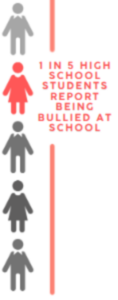 McCarthy emphasized the importance of kindness during her classes and encouraged students to be kind to one another, as even a small compliment could change someone’s entire outlook on their day. She discussed how kindness can carry the possibility of bringing someone out of a depressed state, but the opposite, such as bullying, could send someone into one. According to the National Council for Mental Wellbeing, one in five high school students report being bullied at school. Bullying can include factors often overlooked, such as making threats, spreading rumors, attacking someone (physically or verbally), and excluding someone from a group on purpose. McCarthy encouraged students to look out for friends or classmates who might be experiencing these challenges, and if they are, encourage them to seek help.
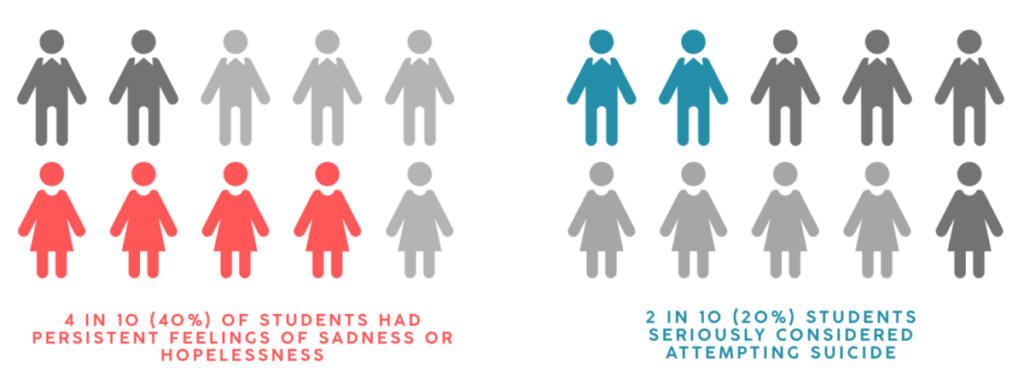
When McCarthy visited Encinal to conduct classes on mental health recently, an important topic she discussed as well was suicide. Another sensitive and serious topic, suicide can be an outcome of depression. As McCarthy stated in one of her lessons, thoughts become actions, and those actions can sometimes include suicide. According to a poll conducted by the Jed Foundation in 2024, 9.5% of high school students attempted suicide in the past year, and according to a poll conducted by the CDC in 2023, 4 in 10 (40%) of students had persistent feelings of sadness or hopelessness, and 2 in 10 (20%) students seriously considered attempting suicide. According to the National Institute of Mental Health, some warning signs someone may be considering suicide can include talk of wanting to die or negative speech in general, withdrawal from friends and family, losing interest in things they previously enjoyed, the use of drugs and alcohol, changes in eating patterns, and more. McCarthy emphasized the importance of looking out for these behavioral patterns in friends especially and loved ones.
If you are struggling with mental health or know someone who is struggling with their mental health, McCarthy provided a few sources available at school if help or support is needed.
- The school wellness center
- The school’s student based health center
- Your school counselor
- McCarthy also added that If you or someone you know does not feel comfortable contacting these sources for help, you could try to confide in a close friend or family member, trusted adult, or even a favorite teacher.
If you or someone you know is having thoughts of suicide or seriously considering attempting suicide, you can contact the suicide and crisis hotline at 988.